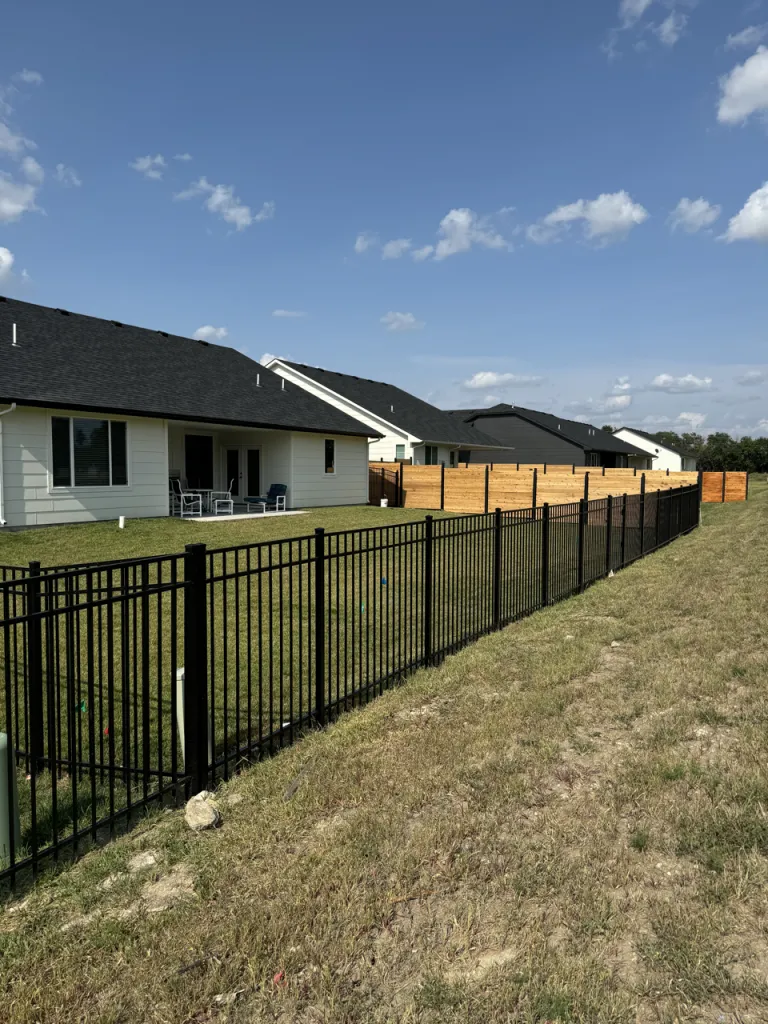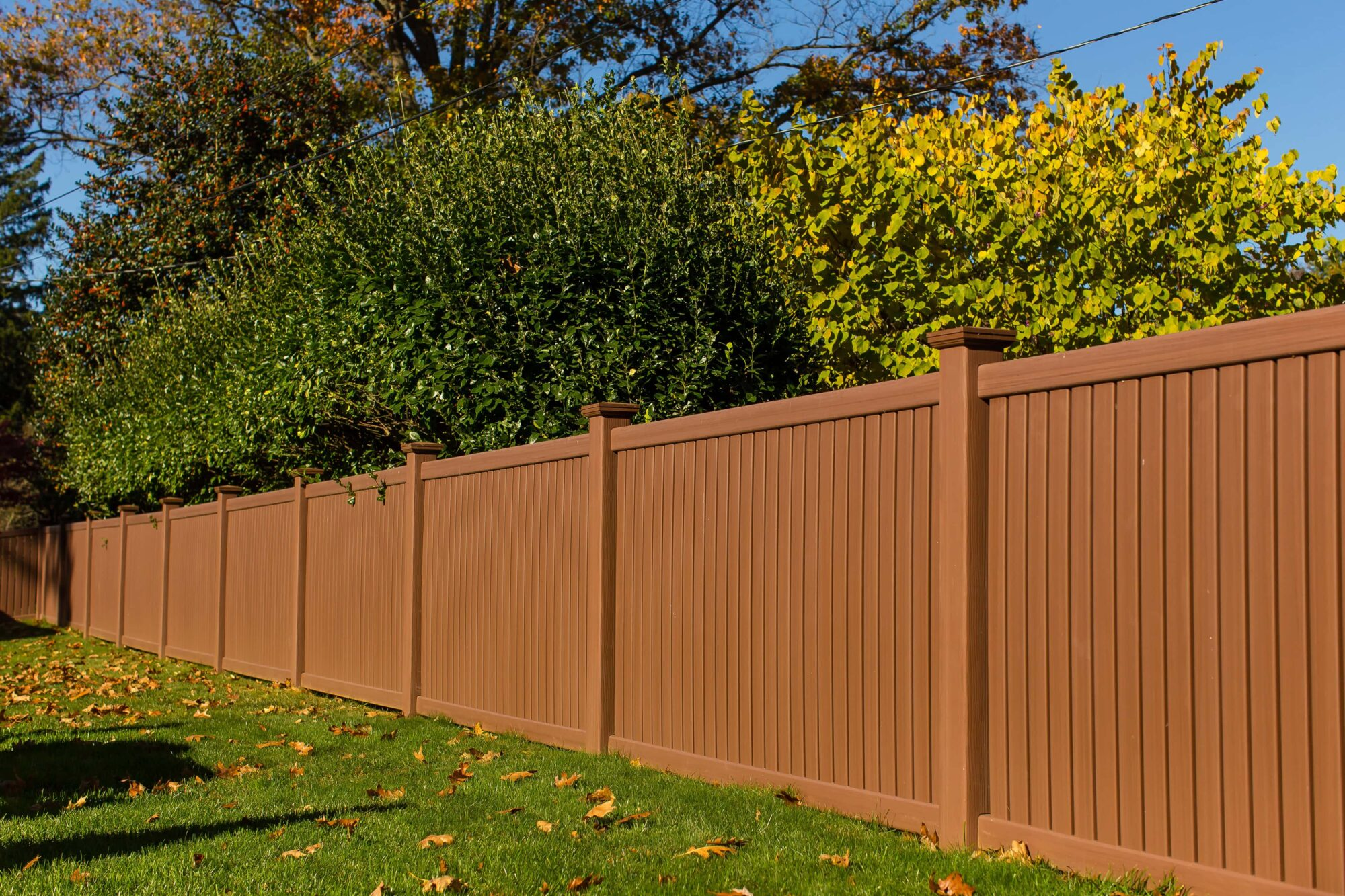

A fence rarely falls over without warning. First one post tips a few degrees, then the top line develops a belly, then the gate that used to latch starts dragging. If you are looking at a fence like that in Wichita, the good news is that leaning fence repair is usually a post repair, not a new fence — as long as you fix the reason the post moved and not just the lean you can see.
This guide is for homeowners in Wichita, Derby, Andover, Haysville, Maize, and the rest of the metro whose wood privacy fence (or vinyl, chain link, or iron fence) has started to tilt, usually after a windy spring, a wet winter, or ten-plus years in the ground. It covers how to find the cause in a few minutes, the Kansas conditions behind most leans, which fixes hold and which only buy time, what repairs typically cost here, and when a leaning fence is telling you it is time to replace it.
The short answer: most fences lean because a post has failed, not because of the boards. If one post wobbles and the wood is soft at the soil line, that post has rotted and needs replacing. If the post and its concrete tilt together, the footing was too shallow or the soil moved, and the post needs to be reset deeper. If the posts are solid but the panel bows, the rails or fasteners have let go. When posts are failing along most of the fence, replacement usually beats repair.
Diagnose a Leaning Fence in Five Minutes
Before you buy a repair kit or call anyone, spend five minutes figuring out what is actually leaning. Every repair decision after this depends on it.
- Find the post where the lean starts. Sight down the top of the fence from one end. Leans start at posts, and the panels on either side are usually just along for the ride.
- Push on the top of that post. Push and pull toward and away from the lean. A post that rocks in the ground has a footing or rot problem. A post that stays put while the panel moves has a rail or fastener problem.
- Watch the concrete. Pull back the grass or mulch at the base. If the concrete collar tips with the post as one block, the whole footing is moving. If the post moves inside a collar that stays still, the wood has rotted or snapped at the ground line.
- Probe the wood at the soil line. Push a screwdriver into the post just above and just below the soil. Sound wood resists. Rotted wood lets the tip sink in, even when the pickets above look fine.
- Note which way it leans and what is nearby. A long run leaning the same way points to wind or soil. One section leaning away from a flower bed, a stack of firewood, a heavy vine, or the neighbor’s fill dirt points to that load.
- Check the gate. If a gate drags, sags, or no longer lines up with its latch, look at the hinge post first. Gate posts carry far more leverage than line posts and are often the first to go.
Use what you found to match your fence to a likely cause:
| What you see | Likely cause | Usual repair |
|---|---|---|
| Post wobbles and the wood is soft at the soil line | Post rotted at the ground line | Replace the post |
| Post and concrete tilt together as one block | Footing too shallow or too small, or the soil around it moved | Reset the post in a deeper footing |
| Post is solid, but the panel bows or leans | Rails split, or nails and screws pulled loose | Re-fasten or replace the rails |
| Post sits higher than its neighbors after winter | Frost heave on a shallow or mushroom-shaped footing | Reset below the frost line in a straight-sided footing |
| A long run leans the same way after a storm | Wind load on a solid fence with shallow footings | Reset several posts; consider tighter post spacing |
| One section leans away from soil, mulch, firewood, or a vine | A sideways load pushing on the fence | Remove the load, then reset the post if needed |
| Gate drags or won’t latch | Hinge post leaning or undersized | A larger, deeper gate post and an anti-sag brace |
Why Fences Lean in Wichita
National how-to articles treat a leaning fence as bad luck. Around Wichita, it usually comes down to a handful of local conditions working on the posts year after year.
Rot where the post meets the ground
A wood post rots fastest in the few inches just above and below the soil line, where it stays damp but still gets air. Lawn sprinklers that hit the same posts all summer, mulch beds piled against the fence, and concrete collars poured flat or below grade, so rain pools against the wood instead of running off, all speed it up. A post can look fine from the yard and be half gone underground. Posts should be pressure-treated lumber rated for ground contact — the American Wood Protection Association lists fence posts under Use Category 4A or higher — or galvanized steel. That is why many cedar fences are built on treated posts, as our cedar vs. pine fence guide explains.
Clay soil that swells when wet and shrinks when dry
Much of the Wichita area sits on clay-rich soil that changes volume with moisture. In the USDA’s soil survey data for Sedgwick County, close to half of the county’s mapped soil is rated high or very high for shrink-swell in the top three feet — the same depth a fence post sits in. In Butler County, home to Andover, Augusta, and Rose Hill, it is about seven acres in ten. You can look up the soil under your own lot on the USDA Web Soil Survey.
In a wet spring, that clay swells and squeezes the footing. In a dry August, it shrinks and pulls away, opening a gap around the concrete. Every cycle lets the post settle a little further in whatever direction it is being pushed — usually by the wind. That is why a fence that stood straight for years can start leaning after a drought summer followed by a wet spring, and why footing depth and shape matter more here than they do in sandy soil. New subdivisions add one more variable: freshly graded lots can settle for a few years, which our new construction fence guide covers.
Frost heave over the winter
When wet soil freezes, it expands and can grip a post or footing and lift it. Posts set below the frost line in straight-sided footings mostly ride it out. Shallow posts, or footings with a wide “mushroom” top where concrete spilled over the edge of the hole, give frozen soil something to grab. After a few winters the post sits higher than its neighbors and out of plumb. If your fence looks worse every March, frost is a suspect. We set posts for 6-foot privacy fences 30 to 36 inches deep in concrete, below the local frost line, and go deeper on gate posts and wind-exposed lots.
Wind pushing on a solid fence
A 6-foot privacy fence is a wall of boards, and every gust pushes on all of it. Wichita’s prevailing wind blows from the south, March and April are typically the windiest months, and strong north winds arrive behind cold fronts from late fall into spring. An east–west fence takes both broadside. A fence leaning after a storm, or one that leans a little further north every spring, is showing you where its footings gave way. Our wind-resistant fence guide covers post spacing, panel styles that let some wind through, and storm prep.
Weight the fence was never built to carry
- Soil and mulch piled against the boards. A raised flower bed or a neighbor’s fill dirt pushes the fence sideways and keeps the bottom of it wet. A fence is not a retaining wall.
- Firewood, trellises, and heavy decor stacked against or hung from one section.
- Vines. Heavy woody climbers add weight and catch wind. Our guide to vines for chain link fences lists the lighter, fence-safe ones.
- Trees. Roots can shove a post out of line, and limbs resting on the top rail add load in every storm.
- Dogs and kids. A big dog that jumps at the same spot, or kids climbing the fence to fetch a ball, will work a post loose over time. Our best fence for dogs guide covers heights and materials that stand up to it.
How the fence was built
Some fences were always going to lean. The usual suspects when a failed post is dug out: holes only 18 to 24 inches deep, posts set in dirt instead of concrete, posts spaced too far apart for a solid fence, gate posts no bigger than the line posts, and concrete left flat or dished so water collects against the wood. If several posts fail the same way at about the same time, the original build is the cause, and resetting one post a year will never get ahead of it.
How to Fix a Leaning Fence: Repairs from Simple to Structural
Match the repair to the cause you found. Here they are from the quickest to the most involved.
Re-fasten or replace the rails
If the posts are solid and only the panel leans or bows, the problem is in the rails or the fasteners. Split rails get replaced, and loose rails get re-secured to the post with exterior structural screws or galvanized rail brackets. Use hot-dip galvanized or stainless fasteners on treated lumber, because today’s copper-based preservatives corrode plain steel. This is the easiest repair on the list and a reasonable DIY job.
Straighten a loose post that is still sound
A sound post set in dirt or gravel that has simply worked loose can often be straightened in place. Dig out around it, push it plumb, brace it from two directions, and backfill in thin layers, tamping each one hard. Compacted gravel drains better than clay. If it worked loose because the hole was too shallow, though, straightening it in the same hole only resets the clock.
Reset a leaning fence post in concrete
When the post and its concrete collar tip together, the footing was too small or too shallow for the load, or the clay around it shifted. Sometimes you can dig out the low side, pull the post and footing back to plumb, brace it, and pack the gap with gravel or new concrete. That can hold if the original footing was deep enough. If it was not, the lasting fix is to break out the old footing, or set a new post right beside it, and pour a deeper, straight-sided footing with the top crowned so water runs away from the wood.
Replace a rotted post
On a wood fence, the most common leaning fence repair is simply a new post. The rails come off that post, the old post and its concrete come out (or the new post goes in just beside it when the old footing is too big to remove cleanly), and a new ground-contact treated post or galvanized steel post is set plumb in fresh concrete. The rails go back on, with new boards wherever old ones split coming off. New wood will look different from a weathered fence until it is stained — see how to stain a wood fence.
What about leaning fence post repair kits?
The post repair brackets and “menders” sold at home centers are steel stakes driven into the ground beside the post and bolted to it. They can be a reasonable fix for a post that snapped cleanly at ground level above a solid footing, or a stopgap to get through a season. They do not fix a footing that is too shallow, a post that is still rotting above the stake, or soil that is still moving, and in wet clay a driven stake can loosen the same way the post did. Treat them as a bridge, not a cure.
Brace it until it can be fixed
If a section is leaning hard and the repair is days away, brace it so the next windy afternoon does not finish it off. Run a 2×4 at roughly a 45-degree angle from high on the post down to a stake driven well into the ground on the leaning side, and screw it to both. Brace from your own yard, not from the neighbor’s fence or a tree, and keep kids and dogs away from a section that is close to falling.
Before anyone digs: a new post hole counts as excavation. Kansas law (K.S.A. 66-1804) requires notice at least two full working days before you dig, and putting in a fence is one of the projects Kansas 811 says needs the call. Contact Kansas 811 or dial 811 so buried utility lines get marked. Sprinkler lines, invisible dog fences, and wiring you ran to a shed or yard lights are usually private, and 811 will not mark them, so find those yourself.
Can You Fix a Leaning Fence Yourself?
Some of it, yes. A handy homeowner can usually handle:
- Re-fastening or replacing a rail on a solid post
- Straightening and re-tamping one loose post that is not set in concrete
- Clearing soil, mulch, firewood, or vines off the fence
- Temporary bracing
It is usually worth calling a pro when:
- More than one or two posts are leaning, or a whole run is going the same way
- The post is set in concrete, or the concrete moved with it
- It is a gate post, or a corner or end post that holds the rest of the run in line
- The fence is vinyl, chain link, or ornamental iron (more below)
- The fence sits on a shared property line
- You would be digging close to marked utility lines
Breaking out an old footing by hand in Sedgwick County clay is a hard afternoon for a single post, and the most common DIY mistake is setting the new post back in a hole no deeper than the one that failed. For a bigger-picture look at doing fence work yourself versus hiring it out, see DIY fence installation vs. hiring a pro.
Leaning Vinyl, Chain Link, and Iron Fences
- Vinyl. Vinyl posts are hollow, so the concrete footing and any internal reinforcement do the structural work. A leaning vinyl fence almost always means the footing moved or was undersized, and because the panel cannot be nailed back into line, the post usually has to come out and be reset. Our vinyl fence guide covers what a good vinyl install looks like.
- Chain link. The corner, end, and gate posts — the terminal posts — hold the tension of the whole run. If a terminal post leans in, the fabric sags along the line. If a line post leans, it is usually a footing problem rather than a fabric problem. Re-tensioning the fabric after the post is reset finishes the job. See our chain link fence guide.
- Wrought iron and ornamental steel. Posts are set in concrete, and a lean often starts with rust where the post meets the footing or with a footing that heaved. Our wrought iron fence guide explains what causes rust at the base.
What Leaning Fence Repair Costs in Wichita
As planning ranges from our fence repair cost guide, correcting a leaning fence typically runs about $150–$400, and replacing a single post about $100–$250 per post. What moves your number:
- How many posts have failed, and whether they sit next to each other
- Old concrete that has to be broken out and hauled away
- Gate, corner, and end posts, which are larger and set deeper than line posts
- Access — a post behind a shed, under a tree, or tight against a neighbor’s fence takes longer
- Boards and rails that crack coming off an old fence and need replacing
- Material — vinyl and ornamental posts take more work to reset than wood
Midwest Fence gives a free on-site assessment and a written repair quote, repairs fences no matter who installed them, hauls away the old posts and debris, and backs every repair with a 1-year craftsmanship warranty.
Repair or Replace a Leaning Fence?
A leaning fence with one or two bad posts is a repair. A fence whose posts are rotting or leaning all along the line is usually a replacement, because the posts you do not fix this year are the ones that fail next year. Lean toward replacing when:
- Posts are failing in several places at once, especially if they were set shallow
- The fence is 15 years old or more and the rails are rotting along with the posts
- The repair quote is approaching half the cost of a new fence
- You were already thinking about a different height, material, or style
Our 7 signs it’s time to replace your fence has the full checklist, and our fence lifespan guide shows what to expect from each material. If you do replace, every Midwest Fence fence installation includes free removal and haul-away of the old fence.
Neighbors, Permits, and HOAs
- Shared fences. If the fence sits on the property line, it likely belongs to both of you. Talk to your neighbor before resetting posts or pulling boards, and put any cost-sharing agreement in writing. A fence leaning into the neighbor’s yard is also worth a heads-up for safety. Our neighbor fence etiquette guide covers the Kansas basics.
- Permits. Inside Wichita, fences up to 8 feet are exempt from a building permit, and repairs that keep the same height and footprint do not need one. Derby requires a permit for new and replacement fences, and Andover requires a fence permit before work starts, so if a repair grows into rebuilding a run, check with the city first. Our Wichita fence permit guide has the details.
- HOAs. Some HOAs want to approve even repairs, and nearly all do for a change of material, height, or style. Check your covenants before you upgrade during a repair.
How to Keep a Repaired Fence Standing
- Keep soil and mulch a few inches below the bottom of the pickets, and never pile dirt against the fence.
- Aim sprinkler heads away from the fence line.
- Make sure the concrete at each post is crowned above grade so water runs off instead of into the wood.
- Walk the fence in spring and fall and push on every post. Catching one loose post early costs far less than a fallen section.
- Trim limbs that touch or hang over the fence, and keep vines light.
- Latch or tie back gates before storms.
- Stain wood every two to three years to slow cracking and rot, or let our fence staining service handle it.
Our fence maintenance guide has a seasonal checklist for every material.
Leaning Fence Repair FAQs for Wichita Homeowners
Why is my fence leaning?
Almost always because a post has moved. The most common causes around Wichita are wood posts rotting at the ground line, footings set too shallow, clay soil that swells and shrinks with the weather, frost heave over winter, and wind pushing on a solid privacy fence. Soil, mulch, vines, or firewood piled against the fence can push it over too. Push on the post where the lean starts: if it rocks, the footing or the wood at ground level has failed.
Can you fix a leaning fence post without removing the concrete?
Sometimes. If the post is sound and the original footing was deep enough, you can dig out the low side, pull the post and its concrete back to plumb, brace it, and pack the gap with gravel or new concrete. A steel repair stake bolted beside the post can also hold a post that snapped at ground level over a solid footing. If the footing was too shallow or the post is rotted, the lasting fix is a new post in a deeper footing.
How much does it cost to fix a leaning fence in Wichita?
As a planning range, correcting a leaning fence typically runs about $150 to $400, and replacing a single post about $100 to $250. The number of failed posts, old concrete that has to be broken out, gate or corner posts, access, and replacement boards all move the price. A free on-site assessment gets you an exact written quote.
Does homeowners insurance cover a leaning fence?
It depends on why it is leaning. Policies often cover sudden damage from wind, hail, a falling tree, or a vehicle, minus your deductible. A fence that leans because its posts rotted or its footings were shallow is usually treated as wear and tear and is not covered. Check your own policy, and photograph storm damage before any cleanup.
Do I need a permit to fix a leaning fence in Wichita?
Not for a typical repair. Inside Wichita, fences up to 8 feet are exempt from a building permit, and resetting or replacing posts at the same height and location does not need one. Suburbs set their own rules: Derby requires a permit for new and replacement fences, and Andover requires a fence permit before work starts, so check with the city if a repair turns into rebuilding a section. Your HOA may have its own approval process.
Who is responsible for a leaning fence between neighbors?
If the fence sits entirely on one property, that owner is generally responsible for it. If it sits on the property line, both neighbors usually share it, and the practical answer is to talk before any work starts and agree in writing on who pays for what. Do not remove or rebuild a shared fence without your neighbor’s agreement.
Get a Leaning Fence Fixed in Wichita
Whether it is one rotted post in east Wichita, a privacy fence that came out of a Derby or Haysville windstorm leaning north, or a gate post in Andover or Maize that has finally given up, Midwest Fence handles leaning fence repair across Wichita and the surrounding communities on wood, vinyl, chain link, and iron fences. We are locally owned and operated, licensed and insured, we repair fences no matter who installed them, and every repair is backed by a 1-year craftsmanship warranty. For storm and wind damage, we aim to respond within 24–48 hours.
Request your free on-site assessment or call us at (316) 710-5824. We will check every post, show you which ones have failed and why, and put the repair in writing — and if the honest answer is that a new fence makes more sense, we will tell you that too. Learn more about our fence repair service, browse finished work in our gallery, or find your town: Wichita, Derby, Andover, Goddard, Maize, Mulvane, and every other community on our service areas page.