Why a Driveway Gate Is a Different Project in Wichita, KS
A driveway gate in Wichita, Kansas is more than a security feature — it is the most weather-exposed, mechanically complex piece of fencing on most properties. A backyard fence sits still and just needs to hold itself up. A driveway gate has to swing or slide cleanly through tens of thousands of cycles, survive 60–90 mph straight-line wind in spring, shrug off ice and freeze-thaw cycles in winter, and keep a powered operator running through 100°F+ summers and dust-heavy harvest months. When something on a driveway gate fails, it is almost always at the worst time — when the propane delivery is at the curb, when the school-pickup line is forming, or when a thunderstorm is rolling in.
This guide is for Wichita-area homeowners and small business owners weighing a new driveway gate installation in Wichita — whether that is a manual swing gate at the entrance to a long acreage driveway, an automatic ornamental iron gate at a residential entry, or a commercial-grade cantilever gate at a yard near 21st Street North or out by Goddard. We will walk through the gate types we install, which materials hold up best in Kansas weather, how automation actually works (and what to budget for), the setback and HOA rules that vary across Sedgwick County, and the cost ranges you can expect. We serve Wichita, Derby, Andover, Goddard, Maize, Mulvane, Bel Aire, Haysville, Park City, Augusta, Rose Hill, and Valley Center, so most of the local-specifics below come from gates we have already installed in your neighborhood. For service-level details, see our gate installation page.
A note on numbers. Driveway gate sizing, footing depth, operator selection, and safety hardware all depend on the specific opening, material, and exposure. The ranges below reflect what we install across the Wichita area, but every job gets sized to the actual driveway. Your HOA, your local city, and your insurance carrier may also drive specific requirements — confirm before you build.
Choosing the Right Driveway Gate Type
Most driveway gate decisions in our service area come down to four families of gate, plus the question of whether the gate will be manually operated or automated. Each family has a sweet spot and a clear list of trade-offs, and the wrong choice will fight you for years.
Single Swing Gates
A single swing gate is one panel that pivots on a hinge post and opens to one side. They are the simplest, most affordable driveway gate type, and they work cleanly on driveways up to roughly 12 feet wide. They are the standard for side-yard vehicle access, single-car driveways, and rural acreage entries where the truck or tractor only needs one lane.
Single swings are also the easiest gate type to automate, because the operator only has to drive one leaf. The catch is that the gate has to have somewhere to swing — a 12′ leaf swinging 90 degrees needs 12 feet of clear arc. On a Wichita lot tight against a sidewalk or another structure, that arc gets crowded fast.
Double Drive (Bi-Parting) Swing Gates
A double drive gate is two panels that meet in the center and swing open in opposite directions. This is the most common driveway gate setup we install across Wichita, Derby, and Andover. Each leaf is shorter than the equivalent single swing, so the swing arc is smaller, the gate looks more proportional on a wider driveway, and the load on each hinge post is cut roughly in half.
Most residential double drives we build are 12 to 16 feet of total opening, with each leaf in the 6–8 foot range. Above 16 feet, panels start to get heavy enough that operators and hinges get expensive fast — at that point, a slide gate is usually the better engineering choice.
Sliding (Rolling) Gates
A sliding gate rolls horizontally along a track or rail next to the driveway. They are the right call when you do not have room to swing, when the driveway is on a slope (a swing gate cannot clear rising or falling grade without binding), or when the opening is wide enough that a swing gate would struggle structurally.
In Kansas weather, the trade-off with track-mounted slide gates is the track itself. Snow, ice, gravel, leaves, and freeze-thaw debris can foul a ground rail and stop the gate from operating. The fix is regular off-season maintenance and, on more exposed sites, switching to a cantilever design.
Cantilever Gates
A cantilever gate is a slide gate suspended from rollers on the support posts — there is no ground track for the gate to ride on. That single design choice solves nearly every Kansas-weather complaint we hear about slide gates. Snow, ice, mud, and gravel cannot jam a track that is not there. Cantilever gates are heavier-duty, cost more up front, and require a counterbalance length on the back side of the support posts (roughly 50% of the opening width). For commercial properties, contractor yards, and any driveway gate that needs to operate reliably through every Wichita season, cantilever is the gate type we recommend most often.
For homeowners, the decision tree usually looks like this: if your driveway is under 12 feet wide and flat, a single swing or double drive is probably the right answer; if the driveway is wider, sloped, or you simply want the smoothest year-round operation, a slide gate or cantilever wins.
Driveway Gate Materials That Hold Up to Kansas Weather
Material choice on a driveway gate matters more than on an ordinary fence, because a gate has to hold its shape and its tolerance for years. A wood privacy panel can sag a quarter inch and you will not notice. A driveway gate that drops a quarter inch will scrape, miss the latch, or trip the operator’s safety stops.

Wrought Iron & Ornamental Steel — The Most Popular Driveway Gate
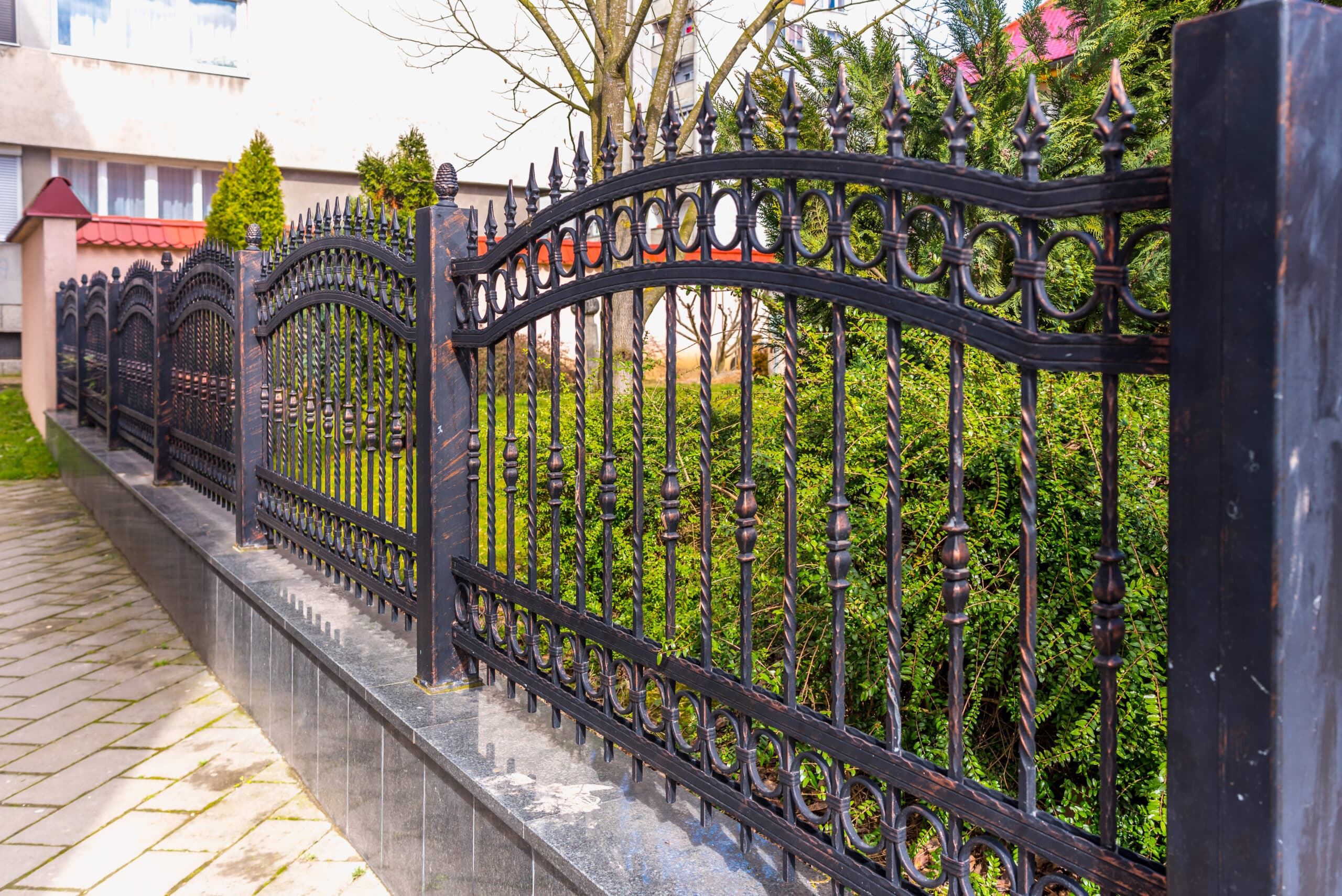
Powder-coated wrought iron and ornamental steel are the most common driveway gate materials we install in Wichita. The reasons are practical: steel does not warp or twist when the temperature swings 70 degrees in 24 hours, it shrugs off most hail without cosmetic damage, modern powder coatings hold up to UV better than paint, and the open picket pattern lets wind pass through instead of catching it like a sail. Our wind-resistant fence guide covers exactly why open-picket designs survive Kansas storms better than solid panels.
Wrought iron is also the cleanest material to automate. Steel frames are stiff and dimensionally stable, so the gate stays in alignment with photo eyes, magnetic locks, and limit switches over thousands of cycles. If you want an automatic driveway gate that is going to look right and work right in five years, this is where we usually start. See our fence types page for full ornamental options.
Wood Privacy Driveway Gates
Wood is the right answer when the driveway gate has to match an existing wood privacy fence — a very common scenario in older Wichita and Derby neighborhoods where wood privacy is the dominant look. We build wood driveway gates on welded steel inner frames so they hold their shape under load. A wood gate built on a pure wood frame will sag within two years; a wood gate built on a steel frame, with proper diagonal bracing, can outlast the privacy fence around it.
The trade-offs are weight (a 6′ tall, 12′ wide wood gate gets heavy fast, which drives up operator size), the need for periodic staining every 2–3 years, and the fact that a solid wood gate catches more wind than the surrounding fence does. We compensate with deeper hinge-post footings and heavier hinges than the spec sheets call for.
Vinyl Driveway Gates
Premium vinyl driveway gates can work well on residential driveways under 12 feet, especially when matching an existing vinyl privacy fence. We build vinyl driveway gates on aluminum or steel internal frames with the vinyl skin attached to the frame — a pure vinyl driveway gate would flex too much under wind load and operator force.
The watch-outs with vinyl are wind exposure (a solid vinyl panel acts like a sail, and the wider the gate, the worse the load) and material grade. Bargain hollow-wall vinyl turns brittle in Kansas summers and cracks under hail. Specify premium virgin vinyl with internal reinforcement. For a head-to-head between vinyl and wood for the surrounding fence run, see our wood vs. vinyl comparison.
Chain Link Driveway Gates
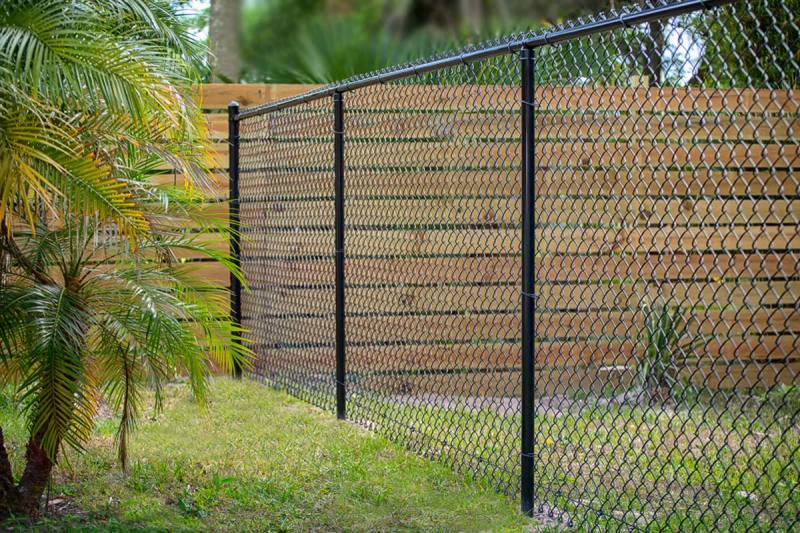
For commercial yards, contractor sites, agricultural properties, and anywhere wind exposure or budget is the dominant concern, chain link driveway gates are the most cost-effective and the most wind-resistant option we install. Galvanized or black vinyl-coated mesh, heavy-duty top rails, and commercial-grade hinge hardware will run for decades on a barely maintained site.
Privacy slats can be added for visual screening on residential or commercial chain link driveways. For a softer look, vinyl-coated black chain link almost disappears against landscaping while keeping every wind-resistance benefit. For a side-by-side read on how each material performs across the full year of Kansas weather, our Kansas weather fence materials guide is the right companion piece.
Automation: How an Automatic Driveway Gate Works
When most people talk about an “automatic driveway gate,” they really mean four interconnected pieces of hardware: the gate itself, the operator (the motor), the access control (how you tell the gate to open), and the safety devices that keep the gate from closing on a vehicle, person, or pet. All four have to be sized and selected together, or the system will fight itself.
Swing Gate Operators
For swing gates, the operator is either a linear actuator mounted between the hinge post and the back of the gate leaf, or an articulated arm operator mounted to the hinge post with an arm that pushes the gate open. Linear actuators are common for residential single-swing and bi-parting double-drive gates up to about 16 feet of total opening. Articulated arm operators handle heavier gates, longer columns, and gates where the hinge post sits behind a column or pier.
Each leaf of a double-drive swing gate gets its own operator. The two operators are wired to a single control board, which sequences them so they open and close in the correct order — an inactive leaf can pin under the active one if the order is wrong.
Slide and Cantilever Gate Operators
Slide and cantilever gates use a horizontal slide gate operator mounted alongside the gate, driving the gate via a rack mounted along the bottom rail. Slide operators are sized by gate weight: residential operators handle gates up to roughly 800–1,000 lbs, and commercial-grade slide operators (typically rated for 2,000+ lbs) are what we install for cantilever gates on contractor yards and industrial sites.
Power: Hardwired vs. Solar
Most automatic driveway gates in Wichita run on 110V hardwired power, fed by a buried conduit from the house, garage, or a nearby outbuilding. Hardwired power gives the operator continuous voltage, supports battery backup that lasts through long outages, and runs accessories like keypads, intercoms, and lights without compromise.
Solar-powered automatic gates are the right call when running 110V to the gate is impractical — a long driveway across a pasture, a property with no utility access at the gate, or a setting where digging a trench through finished landscaping is prohibitive. Solar systems work, but they trade complexity: you depend on adequate sun (Kansas usually obliges, though winter is tighter), you need to size the solar panel and battery bank to the gate’s cycle count, and accessories like keypads and intercoms have to be chosen for low power draw. We size every solar gate for at least three days of cloudy-weather autonomy in the Wichita area.
UL 325 Safety Hardware
Every automatic driveway gate operator we install is configured to UL 325 — the safety standard that governs powered gates in the United States. UL 325 is what determines which photo-eye sensors, edge sensors, loop detectors, and force-monitoring features your operator needs to have, and it changes based on whether the property is residential, commercial, industrial, or restricted-access.
In practice, that translates to:
- Photo-eye sensors mounted on the inside and outside of the gate’s path so the gate stops if anything breaks the beam.
- Sensitive edges along the leading edge of the gate so the gate reverses if it makes contact with a vehicle or person.
- Loop detectors buried in the driveway pavement that detect approaching vehicles and trigger the open or hold-open cycle.
- Battery backup so the gate completes its cycle and fails to a safe state during a power outage.
- Manual disconnect so you can move the gate by hand in an emergency.
A driveway gate without UL 325-compliant safety hardware is a liability — both for the people using it and for the property owner if something goes wrong. We do not install operators without the matching safety package.
Access Control & Smart-Home Integration
Access control is the part of the system most homeowners think about first, because it is the part you actually touch every day. The options we install in Wichita include:
- Keypad entry mounted on a goose-neck post on the driver’s side of the driveway. PIN codes can be programmed per user (delivery driver, lawn crew, family member) and rotated.
- Wireless remotes / fobs for everyday family use — same general idea as a garage door opener.
- Telephone or video intercom at the gate, hardwired or LTE-cellular, that calls a phone or app when a visitor arrives. The visitor speaks with you and you tap a button to open the gate. This is the option most rental and short-term rental hosts choose.
- Smartphone control through the operator manufacturer’s app or a smart-home integration. Most modern operators offer Wi-Fi or cellular modules that let you open, close, and view gate status from anywhere, get alerts when the gate cycles, and grant temporary access codes.
- RFID and card readers for properties where vehicles need hands-free entry, such as farms with multiple drivers or commercial yards with a defined fleet.
- Vehicle exit loops so cars can leave the property without a code or button — a buried loop in the driveway senses the vehicle and opens the gate automatically on exit.
The right combination depends on traffic. A long-driveway home with frequent deliveries usually wants keypad + intercom + remote. A commercial yard usually wants loop sensors + card reader + remote. A vacation home or rental almost always benefits from cellular intercom + smartphone control.
Site Prep, Posts & Driveway Considerations
The most expensive failures we are called out to fix on driveway gates almost never come from the gate itself — they come from undersized posts, shallow footings, or driveway grade that was not accounted for at installation. The construction details that matter:
- Hinge and gatepost sizing. A driveway gate hinge post is doing two jobs: holding up the gate and resisting the wind load on a large solid panel. Our defaults for residential double drives are 6×6 pressure-treated wood or 4″ schedule-40 steel, depending on the gate material. For larger commercial gates and any cantilever installation, we step up to 6″ steel.
- Footing depth. Driveway gate posts go below the Sedgwick County frost line — generally 36″ or more — in oversized concrete footings (typically 24″ diameter for a residential gate post, 30″ for commercial). A driveway gate post poured shallow will heave in a Kansas winter and the gate will stop closing flush by spring.
- Driveway grade. A swing gate cannot clear rising grade. If your driveway slopes up away from the gate location, the gate either has to swing outward (over the public side of the line, which most jurisdictions and HOAs disallow) or be cut to clear the grade. Slide and cantilever gates are unaffected by grade because they move horizontally — one of the most overlooked reasons to choose a slide gate on a sloped driveway.
- Conduit and infrastructure. When we run power and low-voltage to a gate, we always pull more conduit than the immediate need. Two extra conduits buried at the same time as the power feed cost almost nothing extra; trenching back through the same run later for an intercom or a vehicle loop costs many times more.
- Driveway approach drainage. Standing water at the gate location freezes in January and washes a gravel base out by April. Driveway gates need a graded approach that sheds water away from the operating zone.
Setbacks, HOAs & Wichita-Area Permitting
Driveway gate setbacks vary across Sedgwick County and the surrounding cities. The general rule we follow: the gate, when fully open, should not encroach on the public right-of-way, the sidewalk, or a neighboring property. A gate that swings inward off the property line (away from the street) is almost always acceptable; a gate that swings outward or sits flush at the property line is much harder to permit.
- City of Wichita. Driveway gates within the right-of-way generally require a permit. Practical guidance is to set the gate back from the property line far enough that a vehicle can pull off the street, stop in front of the gate, and operate it without sticking into traffic. We typically build that setback at 18–22 feet from the street edge for a standard sedan or pickup, and longer for trailers and delivery trucks.
- Sedgwick County, Derby, Andover, Goddard, Maize, Mulvane, Haysville, Park City, Bel Aire. Similar setback principles apply, with each municipality having its own permit process. The setback distance and the question of whether the gate may swing into the right-of-way are the two pieces that vary most.
- HOAs. Many planned-community HOAs in east Wichita, Andover, and Bel Aire have explicit rules on driveway gate height, materials, finishes (typically requiring black or bronze powder coat over raw steel), and operator-housing visibility. Run the design past your HOA architectural-review committee before you sign a contract.
Our Wichita fence permit guide covers the broader fence-permit basics that often apply to driveway gates as well. When in doubt on a specific lot, we make the call to the local permit office before quoting.
What a Driveway Gate Costs in the Wichita Area
Driveway gate cost in Wichita depends on five factors: material, size, manual versus automated, the operator package, and the site work needed to bring power and control to the gate location. Rough Wichita-area ranges as of early 2026:
- Manual residential single-swing driveway gate (ornamental iron, 12′): roughly $2,500 to $5,500 installed.
- Manual residential double-drive driveway gate (ornamental iron, 14–16′): roughly $4,500 to $9,000 installed.
- Manual wood double-drive driveway gate on steel frame (14–16′): roughly $3,500 to $7,500 installed.
- Automatic residential single-swing driveway gate (gate + operator + basic access control): roughly $6,500 to $12,000 installed.
- Automatic residential double-drive driveway gate (gate + dual operators + access control + UL 325 safety package): roughly $9,500 to $18,000 installed.
- Commercial cantilever slide gate with commercial-grade slide operator and full access control: roughly $15,000 to $35,000+ installed, depending on opening width and access-control sophistication.
Trenching long power runs across the property, custom ornamental design work, and high-end access control (cellular intercom, multi-camera, advanced smart-home integration) all add to those ranges. Our 2026 fence cost guide covers fence-side pricing if you are planning a gate as part of a full-perimeter fence project. Financing is available through Hearth, and most homeowners we work with on automated driveway gates use monthly payment options.
Maintenance & Long-Term Care
A driveway gate is the only piece of fencing on your property with moving parts, and moving parts need a maintenance routine. The schedule that keeps gates running well in Kansas weather:
- Quarterly: wipe down photo eyes and edge sensors, check hinge tightness, listen for any new noises during a cycle, watch the gate close and confirm it is hitting the latch flush.
- Twice a year: lubricate hinges and operator pivot points (manufacturer-specified lubricant only — generic spray can wash out in three rains), check operator chain tension if applicable, vacuum dust and insect debris out of the operator housing.
- Annually: replace the battery backup if it is over three years old, test the manual disconnect, run a force-test on the operator’s reverse function, inspect the hinge-post footing for any new movement.
- After every major storm: walk the gate, check that it cycles cleanly, and verify the latch and stops are still aligned. Hinge-post footings can shift in 70+ mph wind even when the rest of the fence looks fine. Our fence repair team handles post-storm gate work across the metro.
Our fence maintenance guide for Wichita homeowners covers the broader maintenance routines for the surrounding fence; the gate-specific schedule above is on top of that. Most operator manufacturers also issue firmware and access-control software updates a few times a year — we register every operator with the manufacturer at install so the homeowner gets those updates and any safety-recall notifications directly.
Our Driveway Gate Installation Process in Wichita
Every driveway gate project we take on follows the same steps, the same way we run every new fence installation:
- Free on-site estimate. We walk the driveway, measure the opening, look at grade, identify where power can come from, talk through how you will use the gate (daily traffic, deliveries, multiple users), and recommend a gate type, material, and access-control package that fits the site.
- Written quote with options. Material upgrades, operator tier, access-control add-ons, trenching scope, and any HOA-driven finish requirements are called out as separate line items so you can compare apples to apples.
- Permitting & utility locates. We pull permits where required and call in utility locates before we dig — you will see flags and paint on your driveway before we break ground.
- Installation. A typical residential automatic driveway gate is a 2–4 day install: dig and pour footings, set posts, build or hang the gate, run power and low-voltage conduit, mount and program the operator, install access-control and safety hardware, and tune photo eyes and edges.
- Walk-through and training. We do not leave the site until you have opened and closed the gate from every device you own, set up your own PIN codes, and seen the manual disconnect operate.
- 1-year workmanship and materials warranty on every fence and gate we install. If something fails inside the warranty window, we come back out and fix it — no separate trip charge, no quibbling.
Most automatic driveway gate projects in Wichita schedule 3 to 6 weeks out from contract signing, depending on material lead time, custom fabrication, and operator availability. We will tell you up front where your project sits in that range.
Frequently Asked Questions About Driveway Gates in Wichita
How much does an automatic driveway gate cost in Wichita?
For a typical residential automatic driveway gate in the Wichita area, plan on $6,500 to $12,000 installed for a single-swing setup and $9,500 to $18,000 installed for a double-drive setup. That includes the gate itself, the operator(s), basic access control (keypad and remotes), and UL 325-compliant safety hardware. Long trenching runs, premium ornamental designs, cellular intercoms, and smart-home integration all add to those ranges. Commercial cantilever installations run $15,000 to $35,000+ depending on opening width and access-control complexity.
Do I need a permit for a driveway gate in Wichita, KS?
In most cases, yes — particularly if the gate sits within a public right-of-way or exceeds height limits the city applies to ordinary fences. The setback rules for the gate itself, especially how far it sits back from the street so a vehicle can pull off and operate it safely, are the most common pinch point. Confirm specifics with the City of Wichita permit office (or your municipality’s building department) before you build, and run the design past your HOA if your neighborhood has one. Our Wichita fence permit guide covers the basics that overlap with driveway gate rules.
Swing gate or slide gate — which is right for a Kansas driveway?
For driveways under 12 feet wide on flat lots with room for the gate to swing inward, a single swing or double drive is usually the simplest and most affordable choice. For wider driveways, sloped grades, tight property lines, or commercial sites that need the most reliable winter operation, a slide or cantilever gate is the better engineering fit. Cantilever gates are our go-to when winter performance matters most, because there is no ground track for snow, ice, or gravel to jam.
How does an automatic driveway gate work in a power outage?
Every automatic driveway gate we install includes a battery backup that runs the operator through short-to-medium outages — typically enough cycles to get you in and out for several hours. For longer outages, every operator also has a manual disconnect: a key-operated lever that disengages the motor so you can swing or slide the gate by hand. We walk every homeowner through the manual disconnect at the install walk-through so you are never trapped on either side of the gate.
Can I add an automatic operator to my existing manual driveway gate?
Often, yes — but it depends on the existing gate. A well-built steel-frame gate in good condition is usually a clean candidate for retrofit automation. A wood gate built on a wood frame, or any gate that is already sagging or out of alignment, is not — the operator’s force will accelerate failures the gate already has. We retrofit operators on existing gates regularly across Wichita and the surrounding cities, but we always inspect the gate first and tell you straight whether it is a good candidate.
How long does it take to install an automatic driveway gate in Wichita?
From contract signing to walk-through, most residential automatic driveway gate projects run 3 to 6 weeks. Scheduling is usually limited by material lead time (custom ornamental fabrication runs 2–4 weeks) and operator availability rather than the install itself. The on-site work — pouring footings, hanging the gate, running power, mounting and programming the operator — usually takes 2 to 4 days.
Build a Driveway Gate That Works All Year in Kansas
Whether you are putting an entry gate at the front of an acreage in Goddard, replacing an aging manual gate at a Derby home, or speccing a commercial cantilever for a yard near 21st Street North, Midwest Fence designs and installs driveway gates across Wichita, Derby, Andover, Goddard, Maize, Mulvane, Bel Aire, Haysville, Park City, Augusta, Rose Hill, and Valley Center — built to local soil, local wind, and local code, with a 1-year workmanship and materials warranty on every job.
Request your free driveway gate estimate or call us at (316) 710-5824. We will walk your driveway, talk through the right gate type, material, and automation level for your property, and give you a straight answer on what your project will cost and how long it will take.