Why a Good Pool Fence Matters in Wichita, KS
A pool fence in Wichita is one of the most important upgrades a pool-owning family can make. A well-built barrier keeps small children and pets out of the water when no adult is watching, satisfies most homeowner insurance requirements, and — in the right material — adds real curb appeal to your backyard. Pool drownings remain a leading cause of accidental death for children under five nationally, and most involve a pool that was not separated from the house or yard by a proper barrier.
This guide is written for Wichita-area homeowners who are installing a new pool, replacing an aging pool fence, or tightening up a barrier that no longer meets insurance or HOA expectations. We cover what a compliant pool fence typically looks like, which materials work best in Kansas weather, how to set up a gate correctly, and the real-world mistakes we see every season on Wichita, Derby, Andover, Goddard, Maize, Bel Aire, and surrounding Kansas properties.
A quick note on code: The numbers and rules below reflect widely cited industry best practice — specifically the International Residential Code (IRC) Appendix G / R326 and the APSP-7 pool barrier standard. Your specific requirements in Wichita or Sedgwick County may differ, and your HOA or insurance carrier may require something stricter. Always verify current rules with the City of Wichita permit office before you build.
What a Code-Compliant Pool Fence Typically Looks Like
Most residential pool codes across Kansas and the United States are built around the same set of principles, which is why “pool fence requirements” look fairly consistent from city to city. Here is what you will see most often:
- Height — and Wichita is stricter than the model code. National pool-safety pages quote a 48-inch (4-foot) minimum. Inside the City of Wichita the requirement is a 60-inch (5-foot) enclosure, impenetrable to humans. Build to 60 inches here, and confirm the number with your permit office if you are outside the city.
- No more than 4 inches of gap under the fence, between vertical pickets, or in any decorative openings (the “4-inch sphere” rule — a 4-inch ball should not be able to pass through).
- No climbable surfaces: horizontal rails should either be inside the enclosure, more than 45 inches apart, or absent. Solid fences cannot have footholds that let a child scale them.
- No opening wider than 1.75 inches if horizontal rails are less than 45 inches apart.
- Gates latched whenever the pool is unsupervised. Wichita city code requires the gate to be latched when an adult is not present, with a latch that reasonably prevents children getting in. Self-closing, self-latching hardware that swings away from the pool, with the latch mounted out of a child’s reach, is what we recommend and install — it is the model-code standard and it removes the chance of someone simply forgetting.
- No direct pool access from the house without additional alarms or a self-closing door, if the home wall is used as part of the barrier.
These are the targets a good installer builds toward by default. If your Wichita permit office or HOA requires something different, we adjust. If they do not have a specific local rule, we still recommend meeting the national standard above — it is what most homeowner insurance carriers reference when they ask for a “compliant” pool barrier.
Best Pool Fence Materials for Wichita Homes
The right pool fence material depends on your priorities: unobstructed view, privacy from neighbors, maintenance time, budget, and how well the material handles Kansas wind, heat, and chlorine exposure. Here is how the options we install compare for pool enclosures. For a broader read on how each holds up year to year, see our fence materials guide for Kansas weather.
Wrought Iron — The Most Popular Pool Fence in Wichita
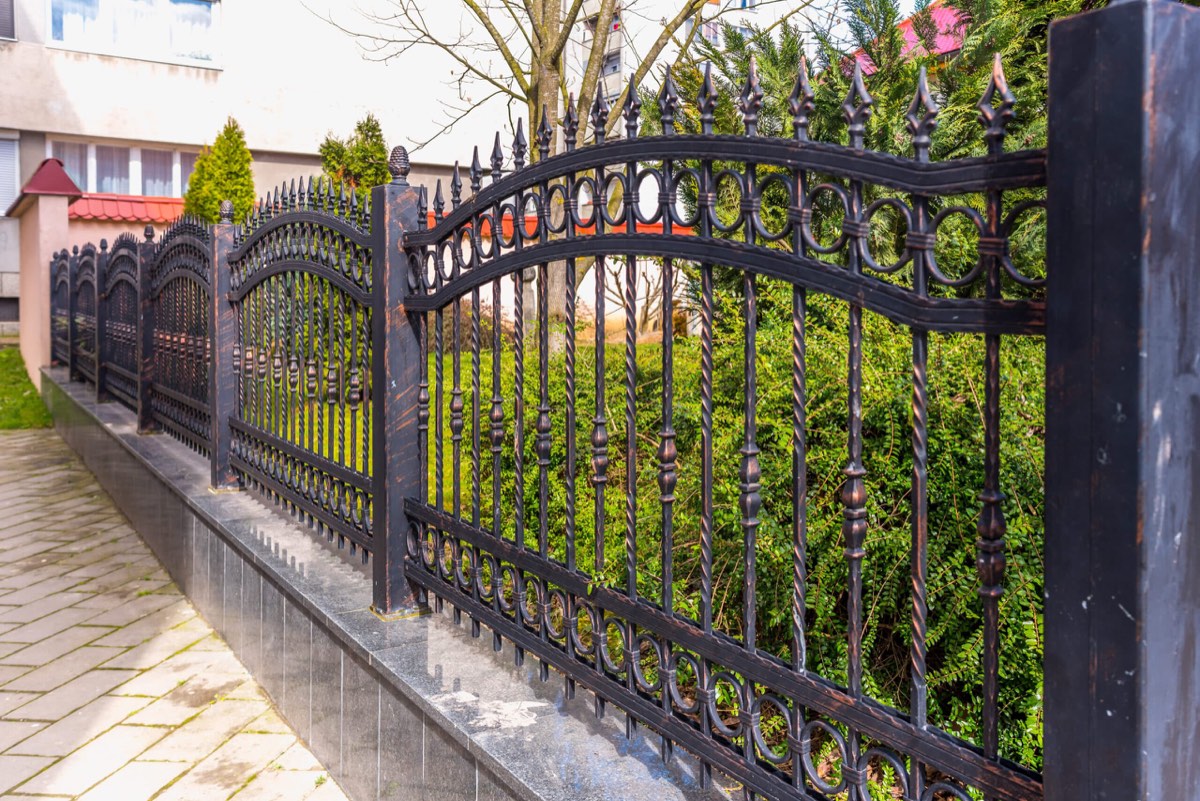
Wrought iron (and powder-coated ornamental steel) is the most common material we install for pool fencing across Wichita and the surrounding communities. The reasons are straightforward:
- Vertical pickets give you a clean, unobstructed view of the pool from the house — critical for supervising kids.
- Tight picket spacing meets the 4-inch sphere rule by default, with no decorative climbable features.
- Modern powder coatings resist rust far better than old-style raw iron, even with chlorine splash.
- Lifespan of 40–70 years with basic care, per our fence lifespan guide.
Wrought iron is also the strongest option in a Kansas hailstorm. For most Wichita pool owners who want a balance of safety, beauty, and durability, this is our first recommendation. Learn more on our fence types page.
Vinyl Pool Fencing — Privacy Without the Maintenance
If your pool sits close to a neighbor or a busy street and you want privacy, premium vinyl is an excellent pool fence material. Vinyl does not rot, does not rust, and will not be damaged by chlorinated splash. A garden hose is the only maintenance it needs.
Two things to plan for with vinyl around a pool: choose a semi-private or ornamental vinyl style (rather than a solid privacy panel) if the pool is tucked behind the fence — you still want sight lines from the house. And specify premium virgin vinyl with internal reinforcement so Kansas wind does not flex or crack the panels over time.
Chain Link (Vinyl-Coated) — Budget-Friendly and Wind-Resistant
Vinyl-coated chain link is the most affordable pool fence material in the Wichita market and the most wind-resistant option available. Wind passes straight through the mesh instead of pushing against the panels, which matters on open Kansas lots where gusts regularly exceed 40 mph.
For pool safety, you want standard or smaller mesh (2 inches or less) in a minimum 4-foot height, with the weave oriented so it is not easily climbed. Black vinyl coating disappears visually against landscaping and protects the galvanized steel underneath from chlorine.
Aluminum / Ornamental Iron Look — The Lower-Maintenance Cousin
Aluminum pool fencing mimics the look of wrought iron at a lighter weight and a lower lifetime maintenance footprint. It will not rust in chlorine spray, which is its biggest advantage over steel around a pool deck. The trade-off is impact resistance — aluminum can dent from a stray hailstone or a dropped pool-deck chair in a way wrought iron will not.
Wood Privacy — When It Makes Sense (and When It Does Not)
Wood privacy fences are the most popular fence type in Wichita overall, but they are a specific-use pool material. Wood will block sightlines from the house to the pool, which is bad for supervision. It also absorbs moisture and chlorine, which shortens its lifespan unless you are staining every 2–3 years.
Where wood works well is as the outer privacy boundary of the yard — blocking neighbor sightlines — paired with an inner wrought iron or aluminum pool enclosure. That two-fence setup gives you privacy from the outside and visibility of the pool from the house at the same time.
Pool Gates Done Right
The gate is where most non-compliant pool fences in Wichita fail. A perfectly built 5-foot wrought iron fence becomes useless if the gate sits open because a tired hinge gave up last summer. Here is what a proper pool gate should have:
- Self-closing hinges that pull the gate fully shut from any open angle, without needing a push. We use tension-adjustable hinges so the closing force can be dialed in.
- Self-latching latch that engages automatically when the gate closes — no manual step required.
- Outward swing (away from the pool) so a child pressing against it cannot force it open.
- Latch height of at least 54 inches from the ground on the pool side, above the reach of small children.
- Magnetic or keyed latches for added security on commercial and rental properties.
- No climbable gate features — decorative scrolls and cross-bracing on the pool side of the gate need to stay above the 45-inch line.
A pool gate is a piece of safety hardware, not a decorative element. If your existing gate no longer self-closes and self-latches, treat it as an emergency repair. Our gate installation team in Wichita rebuilds pool gates regularly and can retrofit self-closing hinges and compliant latches onto most existing fence lines. If you are also considering a perimeter or driveway gate alongside the pool barrier, see our driveway gate installation guide.
Kansas-Specific Factors That Shape Pool Fence Decisions
A pool fence in Wichita faces a different set of stresses than one in a milder climate. The ones we plan around on every job:
- High UV and 100°F+ summer heat. Low-grade vinyl yellows and becomes brittle over time — specify UV-stabilized premium vinyl if you go that route.
- Chlorine and saltwater spray. Pool water contact accelerates corrosion on unprotected metals. Powder-coated wrought iron and aluminum both handle it well; bare galvanized chain link benefits from a vinyl coating for longevity.
- Kansas wind. Solid privacy panels around a pool catch wind like a sail. We set posts deeper (typically 30–36 inches with concrete) for solid vinyl and wood, and recommend ornamental or chain link styles in the most exposed yards.
- Clay soil and freeze-thaw cycles. Shallow posts heave in a Kansas winter and pull gates out of alignment by spring. Concrete footings below the frost line are non-negotiable for a pool fence — a gate that drifts out of plumb stops self-latching.
- Hail. Wrought iron shrugs off hail. Vinyl and aluminum can dent or crack in a severe storm. Budget for post-storm repairs if your region is hail-prone.
Common Pool Fence Mistakes We See in the Wichita Area
A few recurring issues we find when we are called out to upgrade an older pool fence:
- Gates that no longer self-close. Tension-spring hinges lose force over a few seasons. If the gate does not close on its own from a 45-degree angle, it is not compliant.
- Latches mounted too low. A latch at 36 inches is reachable by a 3-year-old on tiptoe. Move it to 54 inches or higher.
- Decorative horizontal rails on the outside. These act as a built-in ladder for a determined kid. Pool-side smooth faces are non-negotiable.
- Posts set in the pool deck concrete. Post bases sitting in constantly wet concrete rot or rust faster. We prefer setting posts in their own concrete footings offset from the pool deck slab.
- The house wall used as the fourth side with no pool-door alarm. If your patio door opens directly onto the pool deck, you need either a self-closing door or a door alarm to meet most compliance standards.
- Above-ground pools with no fence. A 48-inch above-ground pool wall is not automatically a compliant barrier unless the ladder is removable or locked. A standalone pool fence around the deck is almost always required.
What Installation Looks Like with Midwest Fence
Every pool fence project we do in Wichita starts with a free on-site estimate. We walk your yard, confirm where your pool deck sits relative to property lines and setbacks, talk through barrier height and material options, and lay out where the gate(s) should go for best supervision and traffic flow.
From there, the typical process looks like our standard fence installation workflow:
- Estimate & design. Free site visit, line measurement, material selection, and a written quote with financing options.
- Scheduling. We schedule around pool-deck concrete work, landscaping, and your family’s calendar.
- Installation. A typical residential pool enclosure is a 1–3 day install for a standard yard. Old fence removal is free on every job.
- Walk-through. We test every gate hinge, latch, and post before we call it done, and you get a 1-year workmanship and materials warranty.
For detailed pricing on each material, see our 2026 fence cost guide. Pool fence pricing typically sits in the middle of those ranges because of gate hardware and the extra attention that safety-rated installations require.
Frequently Asked Questions About Pool Fencing in Wichita
How tall does a pool fence need to be in Wichita, KS?
Sixty inches — five feet — inside the City of Wichita. The 48-inch minimum quoted on most national pool-safety pages comes from model code and is not the Wichita number, so a barrier built to 4 feet here is short. The city also requires the enclosure to be impenetrable to humans and the gate to be latched whenever an adult is not supervising. Surrounding communities set their own requirements and your HOA or insurance carrier may ask for more, so confirm before you order panels.
Does a hot tub need a fence in Kansas?
In Wichita, yes — unless it is covered. City code folds hot tubs, spas and whirlpools into the same rules as pools, and applies them to any pool two feet or more deep, above ground or in ground. The code accepts a locked spa cover, or a power safety cover meeting the ASTM F1346 standard, in place of the 60-inch enclosure. For most hot tub owners the locked cover is the simpler and cheaper path.
What is the best pool fence material for Kansas weather?
For most Wichita-area homes, powder-coated wrought iron hits the best balance of safety, visibility of the pool from the house, hail resistance, and lifespan. If privacy from neighbors is a priority, premium vinyl is the next choice. If budget is the driver, vinyl-coated chain link in black is a great low-profile option.
Do I need a permit for a pool fence in Wichita?
The City of Wichita requires building permits for certain fences, and pool barriers are often held to a higher standard than ordinary yard fences. Permit rules change, so confirm current requirements with the City of Wichita permit office (or your municipality’s building department) before you start. Our Wichita fence permit guide is a good starting point.
Ready to Build a Safer Backyard?
If you have a pool in Wichita, Derby, Andover, Goddard, Maize, Mulvane, Bel Aire, Haysville, Park City, Augusta, Rose Hill, or Valley Center, Midwest Fence can design and install a compliant, good-looking pool fence that works for your family and your property. Every quote is free, every install carries a 1-year warranty, and we remove your old fence at no charge.
Request your free pool fence estimate or call us at (316) 710-5824. We will walk your yard, talk through the options, and give you a straight answer on what your project will cost and how long it will take.