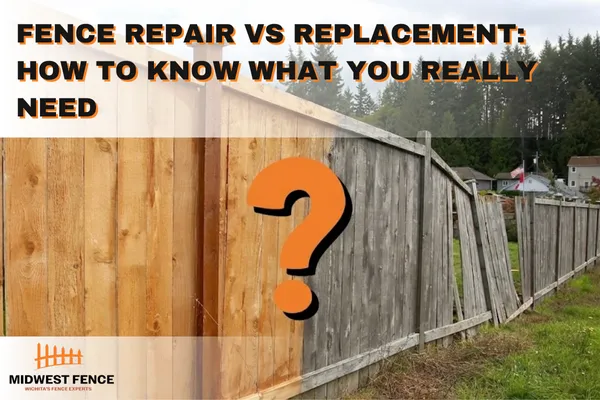
Fence Repair vs Replacement in Wichita: How to Know What You Really Need
Fence Repair vs Replacement in Wichita: How to Know What You Really Need
“Do I just patch this or do I need a new fence?”
Here’s our simple rule of thumb at Midwest Fence:
Repair if: the damage is in a few spots, the posts are solid, and the fence still does its job.
Replace if: the fence is leaning in many places, posts are rotten or loose, or you’re constantly fixing new problems.
Ask a pro if you’re unsure: we look at structure first, not just the boards you can see.
Let’s walk through how to decide, using what we actually look at when we step into a Wichita backyard.
1. Start Here: What Do You Want Your Fence to Do?
Before we talk money or materials, ask a simple question:
“What do I need this fence to do for me over the next 10 years?”
Common answers we hear:
Keep kids or dogs in
Stop people from seeing into the yard
Keep the property looking clean and cared for
Stand up to Kansas wind better than the last one
If your current fence no longer does those basic jobs, replacement often makes more sense than another band-aid repair.
If it mostly does the job and has a few obvious weak spots, repair can be a smart move.
2. When Fence Repair Makes Sense
In Wichita, repair is usually a good option when:
A. Only a Small Area Is Damaged
Examples:
One or two broken cedar pickets
A single section leaning because a post cracked
A gate that drags or won’t latch
If 80–90% of the fence is still solid, it’s often cost-effective to repair the bad spots and extend the life of what you have.
Good candidates for repair:
Strong, solid posts when you push on them
Boards that are weathered but not rotten
No major gaps along the bottom or between pickets
👉 When we come out for repairs, we’re usually looking to save as much of the good structure as we can. You can read more about that on Fence Repair & Maintenance.
B. The Fence Is Still Relatively Young
If the fence is:
Well-built
Under about 10–12 years old
Has one area that took storm damage or a hit from a tree, vehicle, etc.
…then a targeted repair can make a lot of sense.
We’ll often:
Reset or replace a couple of posts
Swap broken pickets for new cedar
Re-hang or rebuild the gate
This gives you more years out of your original investment without paying for a full tear-out and rebuild.
C. You’re Planning a Full Redesign Later
Sometimes you know you want a whole new fence style (iron, vinyl, new layout), but not this year.
In that case, we’ll often recommend:
A minimal repair to keep pets in, kids safe, and the yard presentable
Fixing safety hazards first (loose sections, sharp edges, falling panels)
Then you can come back to full replacement when budget and timing line up.
3. When Fence Replacement Is the Better Choice
Here’s where we start leaning hard toward replacement instead of repair.
A. The Posts Are Failing
Posts are the backbone. If they’re bad, the fence is on borrowed time.
Signs the posts are failing:
Whole sections lean when you push them
You see rot or breaks at the base of the post
Concrete is cracked or the post moves inside the concrete
Several posts are tilted in the same direction
You can patch a panel here and there. But if the posts are failing across the yard, you’re paying to keep a weak frame standing.
In most of those cases, we recommend:
Full tear-out
New posts in proper depth
Rebuild with a stronger material layout (often cedar for wood, iron for ornamental)
B. The Fence Has Widespread Rot or Warping
Typical with older pine or older treated wood:
Many pickets are soft or crumbling
Boards twist, curl, or pull away from rails
Large gaps between slats that used to be tight
You can replace tons of pickets on an old frame, but by the time you do:
Labor cost is high
You’re still stuck with older posts and rails
The fence still may not last long
This is one reason we prefer cedar and why we don’t warranty pine. If you’re seeing widespread rot and warping, replacement is almost always the more honest recommendation.
You can read more about the wood choice in our Cedar vs Pine blog on the Residential Fencing page.
C. You’re Constantly Fixing New Problems
If this sounds familiar:
“We fix one section, another goes bad a month later.”
“Every storm knocks something loose.”
“The gate has been ‘temporary’ fixed three times already.”
That’s the classic sign of a fence at the end of its life cycle.
At that point, repair costs are basically a slow-motion replacement. You’re paying in pieces instead of once.
When we see that pattern in a yard, we’ll often sit down and say:
“You can keep patching this, but you’re spending good money on a fence that’s telling you it’s done.”
4. Cost: Repair vs Replacement in Real Terms
Exact numbers depend on your yard, materials, and layout, but here’s how we think about cost, not just the dollar amounts.
Repair Cost Profile
Lower upfront cost
Best when it adds 3–7 more good years to a solid fence
Works well when:
Damage is limited
Structure is still strong
You’re not re-doing the style or layout
Replacement Cost Profile
Higher upfront cost, but
You’re buying:
Brand-new structure (posts, rails, hardware)
Better materials (often cedar or iron)
A fence built to last in Wichita’s wind and weather
We also look at:
“If we repair this, will you call us again in a year or two for another big repair?”
If the answer is yes, replacement is usually the smarter financial decision over the next 5–10 years.
When you’re ready to look at new options, you can explore styles and materials on Fence Installation and Residential Fencing.
5. Wichita-Specific Factors That Matter
We don’t live in a mild climate. Your fence has to deal with:
Strong Kansas wind
Fast temperature swings
Rain, snow, and summer sun
Expansive soils in some neighborhoods
Because of that, we weigh a few extra things in Wichita:
Wind Exposure
Open lots, corner lots, and west-facing yards take more wind load.
Taller fences and solid panels catch more wind like a sail.
If your fence has already blown over more than once, we’ll look hard at:
Post depth
Post spacing
Concrete setting
Panel design (solid vs with slight gaps)
In windy areas, a rebuild with better structure is usually safer than repeated repairs.
Soil and Drainage
If your posts sit in low spots or soggy ground:
Wood posts rot faster
Metal posts can loosen as soil shifts
Sometimes, what looks like “a bad fence” is really “bad drainage around a fence.” In those cases, we may:
Recommend post replacement plus grading or drainage adjustments
Or, if the whole line is compromised, suggest full replacement with a better layout
Material History
If your fence is:
Old pine that’s now soft and twisted
Thin metal that bends easily
Built with undersized posts
…then repair is like trying to make an economy car into a work truck. It’s not about one bad board—it’s the whole system.
That’s why, as Midwest Fence, we push cedar over pine and iron over flimsy ornamental options. We’d rather build it right once than “make do” three times.
6. What Happens If You Do Nothing?
Sometimes people aren’t ready to decide yet. That’s fine, but it helps to know what “wait and see” can look like.
Leaning sections get worse. One small lean becomes a full tilt.
Gaps grow. Pets may start escaping; kids may be at risk around loose boards.
Rot spreads. In wood, once rot starts, it usually doesn’t stop without action.
Storm damage risk increases. A weak fence is more likely to come down in big chunks during a Kansas storm.
If safety or security is involved (dogs, kids, pool, corner lot), we almost always recommend at least a short-term repair to get things safe, then plan replacement if needed.
7. How We Decide On-Site (Our Process)
When we come out to a property for fence repair in Wichita, we walk through a simple process:
Look at the posts first.
Are they solid?
Are they deep enough?
Are they rotting or moving?
Check multiple sections, not just the “ugly” one.
Is this a one-off problem, or a pattern across the fence?
Ask about history.
How old is the fence?
Has it been repaired a lot already?
Ask about your plans.
Are you staying in the house long-term?
Do you want to upgrade style or materials soon?
Then we’ll usually say something like:
“Here’s what repair looks like: cost, life you’ll get out of it, what might still bug you.”
“Here’s what replacement looks like: cost, life span, and what improves.”
And we’ll tell you what we’d do if it were our yard. No pressure. Just straight talk.
You can start that process any time on Fence Repair & Maintenance or the main Services page.
8. Quick FAQ: Repair vs Replacement in Wichita
How do I know if my fence is too far gone to repair?
If more than 25–30% of the fence has serious issues (leaning, rot, missing boards, loose posts), replacement is usually the smarter choice.
Is it cheaper to repair or replace a fence?
In the short term, repair is cheaper.
In the long term, a failing fence that keeps needing work often costs more than one well-built replacement.
Can you repair just part of my fence and replace the rest later?
Yes. We often:
Stabilize the worst sections
Plan a phased replacement
This can help with budget and timing, as long as the structure is safe.
What’s my first step if I’m still unsure?
Start with a walk-through estimate. We’ll:
Inspect your fence
Talk through repair vs replacement
Give you clear options and pricing
You can get that started here: Free Estimate or Fence Installation.
At Midwest Fence, we proudly offer top-quality fencing solutions to Wichita, KS, and the surrounding communities. We serve Andover, Derby, Goddard, Haysville, Maize, Park City, Bel Aire, Augusta, Rose Hill, Valley Center with fencing solutions.
Our experienced team is dedicated to delivering exceptional craftsmanship and customer service across these areas. Whether you're looking for residential or commercial fencing solutions, we're here to meet your needs.
Other Links:


